Tag: Data Center Technician

The tag for Data Center posts about working in a data center.

  • Google’s Data Center Technician Interview Guide

    Google’s Data Center Technician Interview Guide

    In last week’s post I reviewed the skills Google suggests Data Center Technicians have before they apply for one of their open roles. This post reviews Google’s Data Center Technician interview guide (which you can read here) so those with an upcoming interview can hopefully succeed and get an offer. As a Data Center Technician III at Google who interviewed candidates I’m happy this guide is available. Now I have something to give those reaching out to me on LinkedIn asking for interview advice.

    Google’s Data Center Technician Interview Guide: Overview

    Per the website Google designs their interview with two principles:

    • Structured interviewing: Every candidate is assessed using clear rubrics. We use those rubrics for all folks being considered for that role, so that everyone is evaluated from the same perspective, allowing their distinctiveness to emerge.
    • Open-ended questions: We ask open-ended questions to learn how you solve problems. We want to understand how your mind works, how you interact with a team, and what your strengths are.

    What is is rubric? According to Indeed: “An interview rubric, also referred to as a hiring scorecard or scoring sheet, serves as a rating tool to evaluate job-relevant competencies during an interview.”

    Google’s Data Center Technician Interview Guide: Expectations

    Google explains in their interview guide that candidates will have multiple interviews. The recruiter will give the exact number and schedule.

    As for the type of questions, the guide explains they are open-ended. Meaning there aren’t any multiple-choice questions. This way the interviewers can learn how candidates approach and solve problems. Interviewers, like myself, can’t learn that from a multiple-choice question.

    So what type of questions do candidates have to answer? This is what so many people want to know when they reach out to me on LinkedIn or ask on my YouTube channel. Google lays it out:

    • Role-related knowledge (RRK): these questions will relate to the role and your past experiences. Be ready to discuss key role knowledge and industry expertise.
    • Problem solving: interviewers will be evaluating your problem-solving and critical thinking skills. They want to see how you strategically think through scenarios.
    • Leadership: for individual contributor roles, interviewers will look for leadership qualities that demonstrate your potential to grow into future roles. Questions will focus on your ability to get things done, work collaboratively, and strive for self-development.

    These guidelines are pretty self-explanatory. Candidates should be ready to answer questions related to the Data Center Technician role using their past IT experience. They need to showcase good problem-solving and critical thinking skills. Finally, candidates should demonstrate their leadership qualities from their previous and/or current roles as this displays potential to grow into future roles.

    Interview Preparation

    This section is quite long because this is vital to one having a successful interview. After reading the section I do agree with the preparation suggestions:

    • Showcase your strategic thinking
    • Listen carefully and clarify as needed
    • Demonstrate how you navigate complexity and ambiguity
    • Share how you work with people and teams
    • Think about your leadership style
    • Let us know about any accommodations you need

    Some candidates may be strong in these already. If one isn’t, then I highly recommend becoming proficient before the interview. Those individuals can consider participating in a mock interview with a friend or family member. Or they can pay for a mock interview. The latter may be better as those companies do provide actionable feedback and will give their clients the truth about their interview skills.

    I also suggest candidate write down answers to the above topics. If you can’t write down how you work with people and teams, or how you navigate ambiguous tasks then probably won’t explain those well during the interview.

    Look at the interview as an audition. You must practice over and over and over so you will have the best audition possible. If you don’t, then someone else will get the role.

    Behavior Interviews

    I’m glad Google’s Data Center Technician interview guide covers behavior interviews because I think too many candidates focus on the technical interviews too much. Thus, they are unprepared when it comes to behavioral questions.

    These are important because that’s how interviewers learn “how you’ve handled a specific challenge in the past to assess if you’ll be a good match for the role.”

    There’s more I want to say, but I don’t want to overstep any boundaries placed by my employer so I suggest individuals spend a considerable amount of time reading through that section on the guide. Then put into practice the STAR method the guide describes:

    • Situation: Describe the situation you were in or the task you needed to accomplish
    • Task: Explain the goal you were working toward
    • Activity: Detail the specific steps you took and the role(s) you played
    • Result: Describe your accomplishments and the overall outcome

    Use The Provided Resources

    I want to end this post to tell candidates to use the provided resources at the end of the guide. Especially if one has an upcoming interview.

    • Connect with a Googler

    If someone has more questions about the role to see if it will be a good fit for them then ask your recruiter to connect with a Googler. Candidates can also ask to have a mock interview with a Googler. I’ve done both of these with candidates. And one of those candidates now works at Google! (I’m not taking full credit for that because that person had to pass the interview, but I did help that person focus on their strengths and provide tips on how to calm their nerves.)

    • Leverage AI

    It’s fine to use Gemini to prepare for an interview. You can even have a mock interview with the LLM. However, do not use it during the interview! That’s a big no-no and you can (and probably will) get disqualified from the role.

    • Interview Warmup Tool to Practice Answering Interview Questions

    I learned about this tool some time back, but forgot about it until now. Go try it out!

    • Learn more about Google and the Data Center Position

    There are plenty of links on the guide to get more information so please visit them.

    Good luck!
  • Data Center Technician Skills Needed At Google

    Data Center Technician Skills Needed At Google

    One of the top questions I received on LinkedIn and my YouTube channel are the skills one needs to work as a Data Center Technician at Google (or another company). Until recently I would point those individuals to read this blog post I wrote some time back. Why did I change from pointing people to my website? Not because the information is outdated, but that Google released an official website detailing all the skills needed for the role. In this point I want to review the Data Center Technician skills needed at Google.

    Author’s Note: Although this website is geared toward roles at Google, the skills listed are pretty universal and apply to Data Center Technician roles at other employers.

    Data Center Technician Skills Overview

    There are three category of skills one needs to become a Data Center Technician at Google:

    • Infrastructure and hardware
    • Networking and connectivity
    • Problem solving and analytical skills

    Let’s review those in more detail.

    Infrastructure and Hardware

    According to the website, anyone interested in gaining the Data Center Technician skills to pass the interviews need to know the following:

    • Applied data security

    This means having the knowledge of how to handle a server to maintain data security. Thus, one should understand where data lives (such as a hard drive) and how to properly handle data so that person doesn’t compromise it and cause an incident.

    • Data center hardware architecture

    I’m glad Google points out this skill because there are plenty of individuals working in IT that don’t understand the type of hardware within a data center. They are used to office hardware, which is totally different. A person could learn this by watching videos on YouTube and doing research online. However, have physical experience is best.

    • Data center infrastructure

    The website suggest interested candidates know the network, cooling, and power works in a data center. Again, one can learn about this using YouTube. There are plenty of videos there about how a network, cooling structures, and power works in a data center.

    • Data center operating systems

    Candidates need to know how operating systems work when it comes to the boot process and how to troubleshoot issues. Which operating system do people need to know? Linux. It runs a majority of the servers powering the Internet today. However, if people only know Windows I suggest they learn how to use Linux.

    • Machine equipment and components

    Last, but not least, individuals need to know the types of hardware used in servers, how they interact with each other, and how to troubleshoot various types of issues. I always tell people this when they ask about a particular skill-set to study. If you don’t know your computer hardware and troubleshooting steps, you’re not going to get the job.

    Networking and Connectivity

    Now let’s review the suggested computer network skills:

    • Network equipment and components

    People need to know about the various types of network equipment commonly found in data centers. Good examples are fiber optic cabling, switches, routers, and optic transceivers to name a few. Wikipedia and YouTube are great resources to learn if someone doesn’t have experience.

    • Data center network architecture

    This skill can get very complex fast. Basically, the type of network within a data center is similar to one used in a home or office, but on a larger scale. Candidates going for a L1 or L2 Data Center Technician role need to know the basics about data center network architecture. However. those going for more senior roles need to know quite a bit.

    • Computer networking

    I suggest individuals know the Open Systems Interconnection (OSI) model and the common Internet protocols (such as TCP/IP, UDP, and DNS).

    Problem Solving and Analytical Skills

    The last Data Center Technician skills to learn is how to properly troubleshoot problems when they arise, be it on a server or within the network. They also need to understand where to find the information containing the error and other information so they can properly troubleshoot.

    As a L3 Data Center Technician at Google this is what I do everyday. If I’m not troubleshooting a network link or a machine, I’m finding information about the failures so I can do more research.

    Frankly, if one doesn’t have good problem-solving skills then passing the interview is going to be near impossible.

    How Can One Gain These Skills?

    I highly suggest those wanting to get one of Data Center Technician roles at Google to take and pass the Google IT Support Certificate. I took it myself just to see how it was because I used to suggest individuals get the CompTIA A+ certification. Read this blog post for my thoughts about the certificate.

  • More Data Center Work Locations In America To Consider

    More Data Center Work Locations In America To Consider

    This post is a sequel to this post about the best data center work locations to work in America. I recorded a video for my YouTube channel about my article. At the end I talked about more data center work locations people should consider. That got me thinking later on: “I need to write another post.” So here it is! Let’s review more cities and states containing several data centers.

    More Data Center Work Location In America For Data Center Techs To Consider

    Here’s the list of the cities and states hosting more data center work locations in America in no particular order:

    • Chicago, IL
    • Oregon
    • Texas

    Chicago, IL

    I put Chicago on the list because there’s about 100 data centers in the city, and about another 50 to 60 data centers in the outskirts. Thus, there’s plenty of jobs for those looking for both entry-level and experience Data Center Technician roles. The city contains mostly the big colocation providers like CoreSite, Equinix, Digital Reality, and EdgeConnex, but there are Big Tech data centers from companies like Oracle and Microsoft.

    One of the best qualities of the data centers in Chicago, IL is the multiple clusters all around the city. There’s a cluster in the heart of the city. Then there’s a cluster of data centers in the suburbs up in the north and west parts of the city. Finally, there’s a scattering of data center running across of the southside.

    Now, one of the worst qualities of working in Chicago, IL is the cost of living. According to Payscale it costs 14% more to live in the city than the national average. Housing is particularly high at 39%. Finally, the city’s total tax rate is the third highest in America at 10.25%! However, it is cheaper if one moves out to the suburbs.

    Oregon

    Why did I list the entire state of Oregon instead of focusing on a particular city? Because most of the data centers are located in two cities:

    • Portland
    • Boardman

    There’s about more than 30 data centers in either city. And if a person travels to a nearby city, there’s additional ones. So if one is looking for more data center work locations I suggest one of those two cities. They contain data centers from Big Tech companies like Google and Amazon. In addition, there are many data centers from major colocation companies like Flexential, QTS, and Cogent. Thus, there are types of roles for interested individuals.

    One of the best qualities of working in Oregon is the beauty of the state. That’s what I hear from many of the individuals living and working there. They love the outdoors, which is a big reason why they continue to stay in the area. I know this reason isn’t directly related to a Data Center Technician job, but it is part of work/life balance which is important.

    This beauty comes at a price. The cost of living is 10% higher than the national average according to RentCafe. Housing is quite high at 22% above the national average. Transportation is the next highest cost, at 16% higher than the national average. Again, living in the suburbs will reduce those costs than living in the major cities.

    Texas

    Just like Oregon I list the entire state of Texas as an option because there’s over 300 data centers in the state! It’s one of the fastest growing areas for data centers. See the new Stargate Project from OpenAI and Oracle as an example.

    The vast majority of the more data center work locations in Texas are in the Dallas / Fort Worth area. In second place is Houston. Finally, San Antonio and Austin almost tie for the number of data centers in those cities.

    I would say that’s one of the state’s best qualities. If someone doesn’t like the Dallas area, that person could choose to live in Houston instead and get a data center job. Or if that person is weird, and wants to stay weird, then Austin is the perfect choice. As for the type of employers in the state, once again Big Tech has a large footprint, along with the major colocation providers.

    The biggest downside to working in Texas is the cost of living. I know, I’m repeating myself, but it’s higher than the national average. That’s thanks to all the people moving into the state. According to Payscale, the cost of living in Dallas is 2% higher than the national average. However, Austin has a 2% lower cost of living in comparison to the national average. However, one may still run into high housing or transportation costs like many other Americans.

  • Google IT Support Certificate: Great For Entry-Level Roles

    Google IT Support Certificate: Great For Entry-Level Roles

    In my short guide on how to get a Data Center Technician role I suggested individuals look into getting the CompTIA A+ Certification. It’s a popular and widely-accepted certification by various employers. However, that certification is getting more and more expensive as the years go by. So what’s a good alternative? Google IT Support Certificate. And I’m not saying that because I’m a Google employee. I wanted to know first-hand if this certificate is good for those seeking an entry-level IT role so I took the course on Coursera and completed it.

    Let’s Review The Details About The Google IT Support Certificate

    The Certificate’s Objective

    Per its website, the Google IT Support Certificate is for those are new to IT, or individuals with IT experience who want to upgrade their skill-set. However, for this post I will focus on the first category.

    The certificate’s main focus is to provide beginners a solid foundation in the following:

    • Computer hardware knowledge
    • Computer networking knowledge
    • Troubleshooting skills
    • Knowledge about operating systems
    • Information about IT Security and System Administration

    This foundation prepares certificate holders to apply for jobs like IT Support and System Administration.

    The Certificate’s Training Method

    The certificate uses videos hosted on Coursera, allowing students to learn at their own pace. Thus, students can learn the material no matter where they located as along as they have an Internet connection.

    In addition, there are hands-on activities students needs to accomplish to not only proceed in the coursework, but to actually understand what they learned.

    Finally, there are assessments students must pass to proceed through the course. There is a limited on the number of times a person can fail each assessment in a 24-hour period. Then students have to wait a period of time before trying again. I really do like how when I got a question wrong I got a tip on which video to rewatch so I could discover the correct answer.

    The Certificate’s Cost

    Unlike the Comptia A+ certification, the Google IT Support Certificate doesn’t have a fixed cost for the exam. It falls under Coursera’s monthly subscription service of $49 a month. So how much would a student spend to get the certificate?

    The website states if students devotes 10 hour per week toward the coursework they will complete the course in 6 months. Thus, they will spend $294 USD in total. In comparison with the A+ Certification requires two exams each costing $253 USD. That’s only the cost of the exam. The study material is not free.

    The Google IT Support Certificate can be less than $294 if students devote more hours per week to watching the video content and taking the assessments. So this option can save students more money.

    The Certificate’s Major Benefit Over A+ Certification

    The certificate does have one major benefit over the A+ Certification: Access to 150+ employers! That’s through CareerCircle, which provides “free 1-on-1 coaching, interview and career support, and a job board to connect directly with employers, including over 150 companies in the Google Career Certificates Employer Consortium.”

    The companies within this group includes several from the Fortune 500 list:

    • Adobe
    • Dell Technologies
    • Salesforce
    • Ford Motor
    • Target
    • Verizon

    Having the ability to connect to these employers, along with many others, sets up the students for success. They can possibly get a role that will lead to a long career in IT, along with a good salary and benefits. And that’s why I suggest the Google IT Support Certificate.

  • Consider Contract Data Center Technician Jobs

    Consider Contract Data Center Technician Jobs

    The previous week I posted content related to getting a Data Center Technician job. This week continues with those posts, and today I want individuals to consider contract Data Center Technician jobs during their search. I understand getting a permanent position is better because it offers better job security, salary, and benefits. That I want for all interested candidates. However, if someone doesn’t have the experience needed to get an entry-level role, getting a contract role will give that person the needed experience. Let’s review job listings to see the difference.

    Consider Contract Data Center Technician Jobs Because Their Easier-To-Meet Minimum Requirements

    While doing research for this post I went to LinkedIn to view all types of contract jobs. It was the easiest place I could review jobs in a quick fashion. However, I could have used Indeed or Dice to find these jobs too.

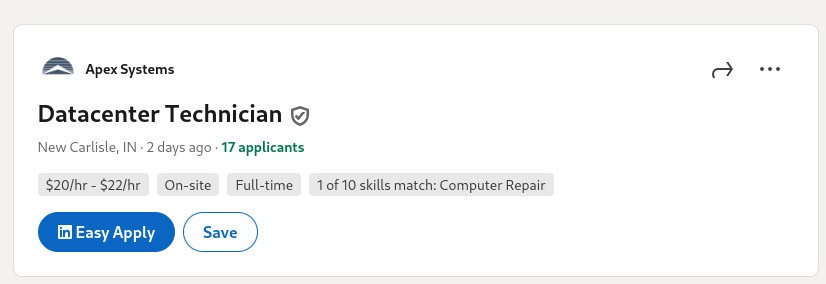
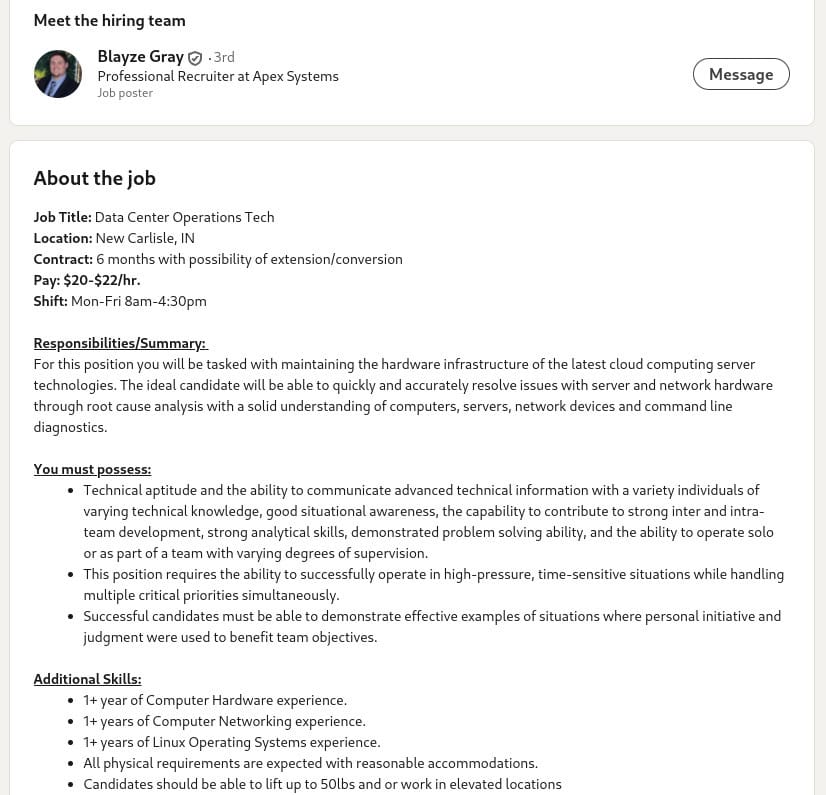
    Since I suggest interested candidates to consider contract Data Center Technician jobs I’ll post one that has easier-to-meet minimum requirements than a permanent role:

    An image of a Data Center Technician job from LinkedIn.
    An image of a Data Center Technician job from LinkedIn.

    Reviewing this job description it offers a decent salary for someone that has at least one year of experience in computer hardware and network experience. Asking for a year of Linux operating system experience while offering that salary is a bit much. However, if an applicant doesn’t have Linux experience, but has the other qualifications I think they would have a good chance of at least getting an interview. Finally, the contract is for six months. After that time period either job extension happens, or the employee gains a permanent role.

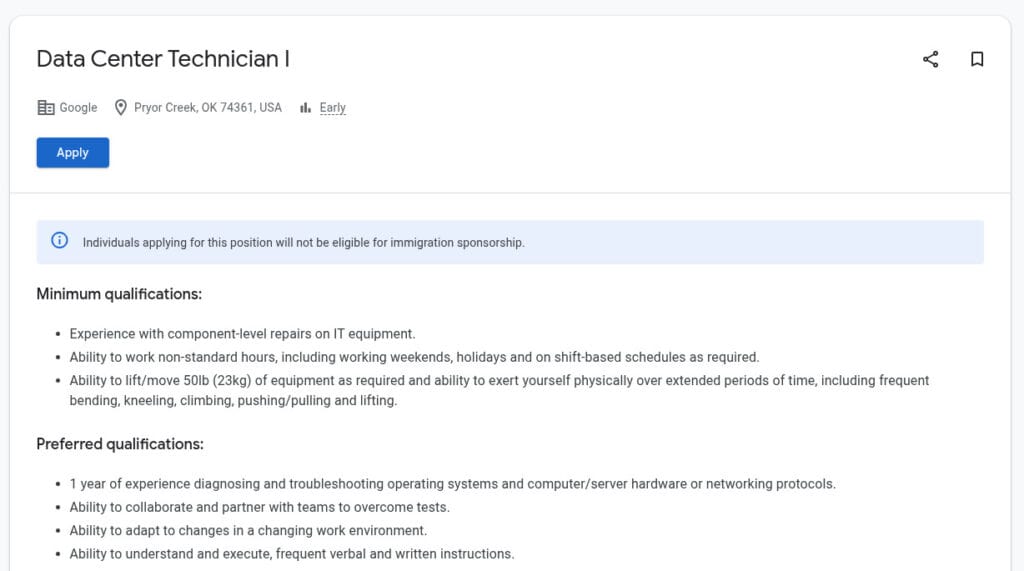
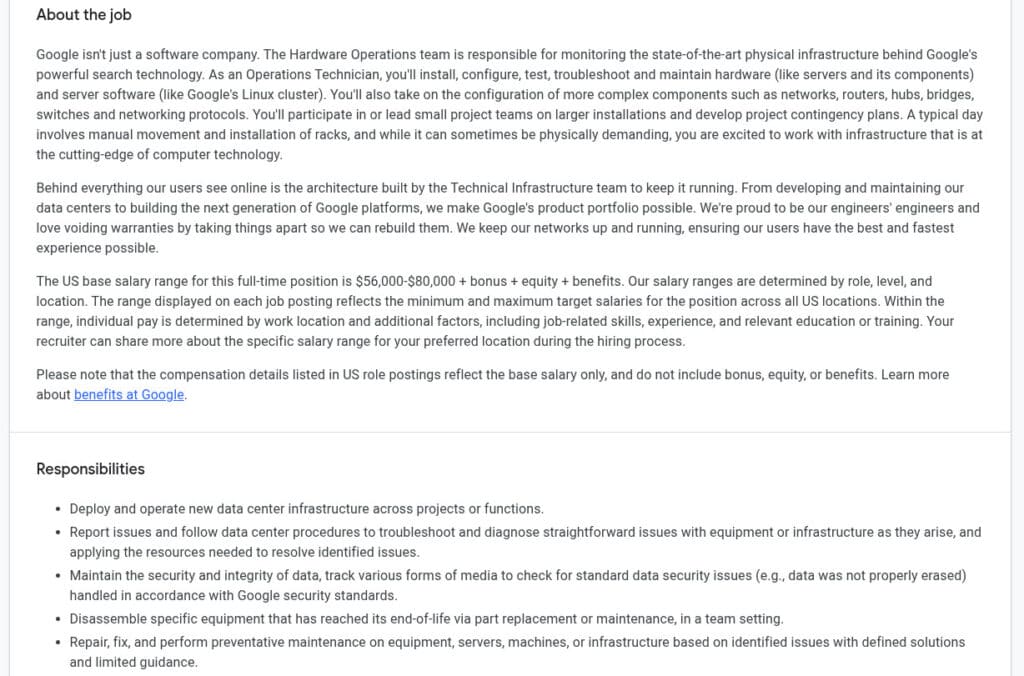
    Now, let’s compare that with a permanent position at a large company. I’ll choose Google since I know they hire quite often for entry-level positions:

    An image of a Data Center Technician job from Google.
    An image of a Data Center Technician job from Google.

    Reviewing this job description it offers a higher salary than the contract position even though it requires the same amount experience with computer hardware and networking. While this job is a good choice too, I would suggest the contract role over this one because of competition. There’s going to be more individuals trying to get the Google job over the contract role. Thus, if an interested applicant doesn’t have all the minimum qualifications that person may not even get an interview.

    Consider Contract Data Center Technician Jobs Because They Are Usually Located Inside A Major Company

    The final reason to consider contract Data Center Technician jobs because they are usually located inside a major company. Thus, it provides the candidate an opportunity to possibly get a permanent job after working a specific length of time.

    Let’s go back to the contract position from above. I wanted to find the client seeking the technician so I did a Google search about data centers in New Carlisle, IN. I found many links pointing to news articles about AWS building a data center in the city. Thus, the client is AWS. Now I really suggest that job to anyone looking for an entry-level role because the job description does state the individual can get a permanent job after six months of work. That means that person would be an AWS employee with a higher salary and better benefits.

    I found another contract job with Insight Global for a role in Boardman, OR. Another quick Google search led me to AWS again. They aren’t the only company that uses contract staff. Many major companies do. It’s just that AWS has so many data centers in America (and around the world) that they need more technicians.

    Sometimes the job descriptions reveal the client’s name, but most of the time they don’t. However, it’s pretty easy now to find out who the client is with a Google search. Also, the recruiter will usually tell interested applicants if they ask.