• Google IT Support Certificate: Great For Entry-Level Roles

    Google IT Support Certificate: Great For Entry-Level Roles

    In my short guide on how to get a Data Center Technician role I suggested individuals look into getting the CompTIA A+ Certification. It’s a popular and widely-accepted certification by various employers. However, that certification is getting more and more expensive as the years go by. So what’s a good alternative? Google IT Support Certificate. And I’m not saying that because I’m a Google employee. I wanted to know first-hand if this certificate is good for those seeking an entry-level IT role so I took the course on Coursera and completed it.

    Let’s Review The Details About The Google IT Support Certificate

    The Certificate’s Objective

    Per its website, the Google IT Support Certificate is for those are new to IT, or individuals with IT experience who want to upgrade their skill-set. However, for this post I will focus on the first category.

    The certificate’s main focus is to provide beginners a solid foundation in the following:

    • Computer hardware knowledge
    • Computer networking knowledge
    • Troubleshooting skills
    • Knowledge about operating systems
    • Information about IT Security and System Administration

    This foundation prepares certificate holders to apply for jobs like IT Support and System Administration.

    The Certificate’s Training Method

    The certificate uses videos hosted on Coursera, allowing students to learn at their own pace. Thus, students can learn the material no matter where they located as along as they have an Internet connection.

    In addition, there are hands-on activities students needs to accomplish to not only proceed in the coursework, but to actually understand what they learned.

    Finally, there are assessments students must pass to proceed through the course. There is a limited on the number of times a person can fail each assessment in a 24-hour period. Then students have to wait a period of time before trying again. I really do like how when I got a question wrong I got a tip on which video to rewatch so I could discover the correct answer.

    The Certificate’s Cost

    Unlike the Comptia A+ certification, the Google IT Support Certificate doesn’t have a fixed cost for the exam. It falls under Coursera’s monthly subscription service of $49 a month. So how much would a student spend to get the certificate?

    The website states if students devotes 10 hour per week toward the coursework they will complete the course in 6 months. Thus, they will spend $294 USD in total. In comparison with the A+ Certification requires two exams each costing $253 USD. That’s only the cost of the exam. The study material is not free.

    The Google IT Support Certificate can be less than $294 if students devote more hours per week to watching the video content and taking the assessments. So this option can save students more money.

    The Certificate’s Major Benefit Over A+ Certification

    The certificate does have one major benefit over the A+ Certification: Access to 150+ employers! That’s through CareerCircle, which provides “free 1-on-1 coaching, interview and career support, and a job board to connect directly with employers, including over 150 companies in the Google Career Certificates Employer Consortium.”

    The companies within this group includes several from the Fortune 500 list:

    • Adobe
    • Dell Technologies
    • Salesforce
    • Ford Motor
    • Target
    • Verizon

    Having the ability to connect to these employers, along with many others, sets up the students for success. They can possibly get a role that will lead to a long career in IT, along with a good salary and benefits. And that’s why I suggest the Google IT Support Certificate.
  • Consider Contract Data Center Technician Jobs

    Consider Contract Data Center Technician Jobs

    The previous week I posted content related to getting a Data Center Technician job. This week continues with those posts, and today I want individuals to consider contract Data Center Technician jobs during their search. I understand getting a permanent position is better because it offers better job security, salary, and benefits. That I want for all interested candidates. However, if someone doesn’t have the experience needed to get an entry-level role, getting a contract role will give that person the needed experience. Let’s review job listings to see the difference.

    Consider Contract Data Center Technician Jobs Because Their Easier-To-Meet Minimum Requirements

    While doing research for this post I went to LinkedIn to view all types of contract jobs. It was the easiest place I could review jobs in a quick fashion. However, I could have used Indeed or Dice to find these jobs too.

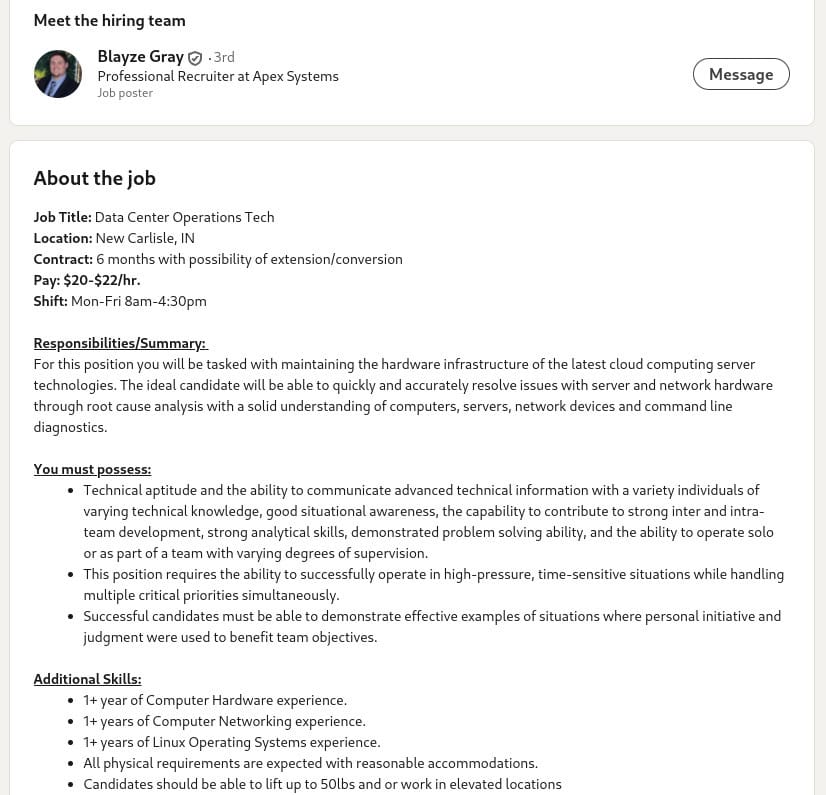
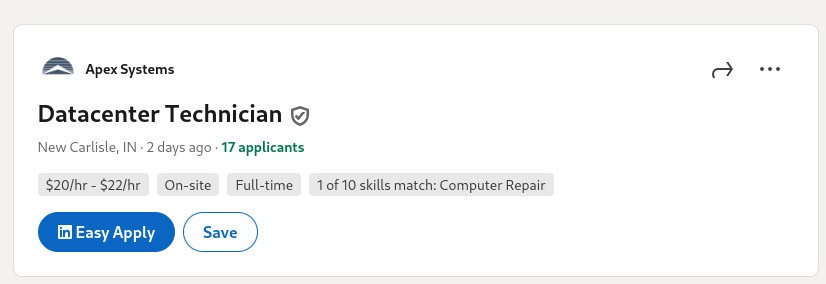
    Since I suggest interested candidates to consider contract Data Center Technician jobs I’ll post one that has easier-to-meet minimum requirements than a permanent role:

    An image of a Data Center Technician job from LinkedIn.
    An image of a Data Center Technician job from LinkedIn.

    Reviewing this job description it offers a decent salary for someone that has at least one year of experience in computer hardware and network experience. Asking for a year of Linux operating system experience while offering that salary is a bit much. However, if an applicant doesn’t have Linux experience, but has the other qualifications I think they would have a good chance of at least getting an interview. Finally, the contract is for six months. After that time period either job extension happens, or the employee gains a permanent role.

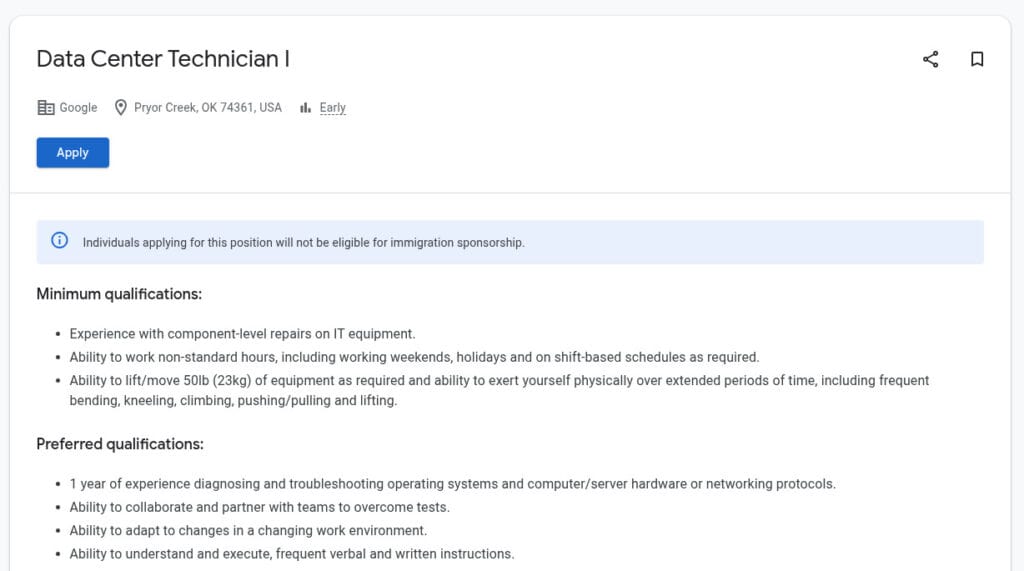
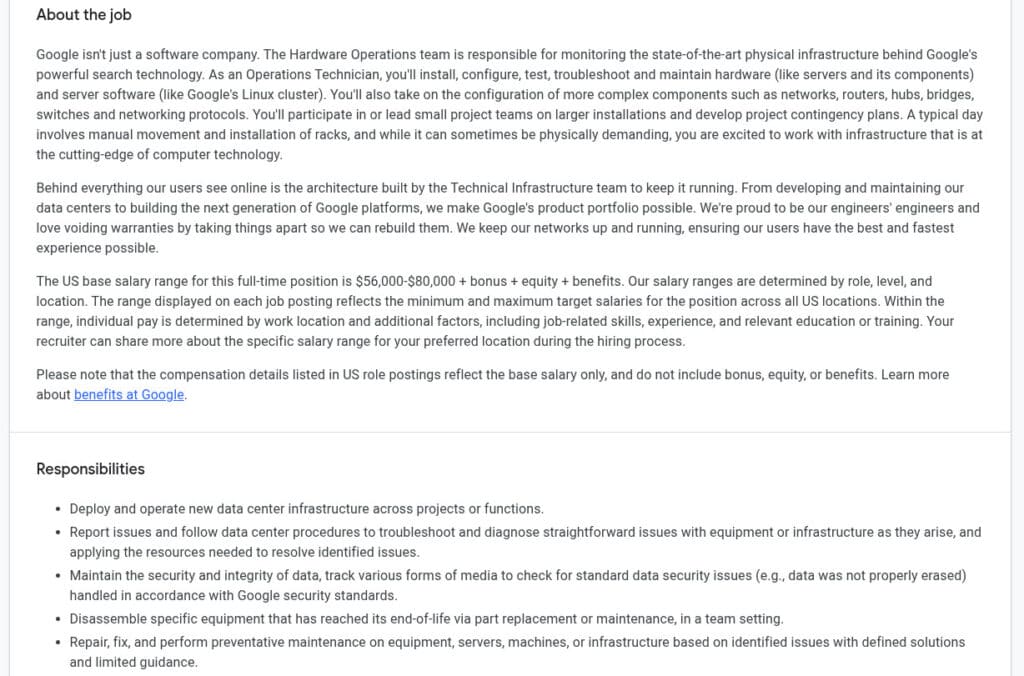
    Now, let’s compare that with a permanent position at a large company. I’ll choose Google since I know they hire quite often for entry-level positions:

    An image of a Data Center Technician job from Google.
    An image of a Data Center Technician job from Google.

    Reviewing this job description it offers a higher salary than the contract position even though it requires the same amount experience with computer hardware and networking. While this job is a good choice too, I would suggest the contract role over this one because of competition. There’s going to be more individuals trying to get the Google job over the contract role. Thus, if an interested applicant doesn’t have all the minimum qualifications that person may not even get an interview.

    Consider Contract Data Center Technician Jobs Because They Are Usually Located Inside A Major Company

    The final reason to consider contract Data Center Technician jobs because they are usually located inside a major company. Thus, it provides the candidate an opportunity to possibly get a permanent job after working a specific length of time.

    Let’s go back to the contract position from above. I wanted to find the client seeking the technician so I did a Google search about data centers in New Carlisle, IN. I found many links pointing to news articles about AWS building a data center in the city. Thus, the client is AWS. Now I really suggest that job to anyone looking for an entry-level role because the job description does state the individual can get a permanent job after six months of work. That means that person would be an AWS employee with a higher salary and better benefits.

    I found another contract job with Insight Global for a role in Boardman, OR. Another quick Google search led me to AWS again. They aren’t the only company that uses contract staff. Many major companies do. It’s just that AWS has so many data centers in America (and around the world) that they need more technicians.

    Sometimes the job descriptions reveal the client’s name, but most of the time they don’t. However, it’s pretty easy now to find out who the client is with a Google search. Also, the recruiter will usually tell interested applicants if they ask.

  • Why I Suggest Data Center Technician Jobs

    Why I Suggest Data Center Technician Jobs

    I’ve spent the last week posting content about how to get a Data Center Technician job. This week I continue with that theme, but in this post I want to explain why. It’s one thing to tell a person to try to get specific role, but sometimes articles or videos don’t explain why. Or they do explain why and focus on the salary and benefits. While those are good, people also want to work a job that matters, or brings them so joy, or keeps them active. That’s the reason for this post. So keep reading to understand why I suggest Data Center Technician jobs.

    Why I Suggest Data Center Technician Jobs: It’s Great For Those Who Like Physical IT Jobs

    When I think about the various positions available in the IT Industry many of them are sedentary. I sat in a chair for a majority of my eight hour shift as a Technical Support Technician. I got up to go to the bathroom or to lunch. Software Engineers, Database Administrators, and Network Engineers all sit down for the majority of their day. Some employers installed standing desks, but a recent study shows those don’t really help improve a person’s health.

    That’s why I suggest Data Center Technician jobs to individuals who are physically active in their personal life. And they want a job where they can stay physically active. I covered the physicality of the job in this previous post, but I will give a quick summary:

    • Data centers are large buildings so there is near-constant walking
    • Server racks are tall so one has to squat, kneel, and climb ladders to access the servers
    • Computer hardware is heavy, and require a good amount of strength to move it around

    Why I Suggest Data Center Technician Jobs: It’s Great For Those Seeking Variety In Their Shift

    The next reason why I suggest Data Center Technician jobs is for the individuals who want to work on a variety of tasks during their shift. Some of these individuals want this because it makes the work day go by faster. Others just don’t want to do the same thing over and over.

    Just like other IT jobs, this role requires each technician to perform a tasks that came in through a ticket. One ticket could have that individual rack and stack networking hardware and servers in a rack. The next ticket for the day could have that individual run Ethernet cabling across the floor to a communications closet, or into a customer’s rack. Another ticket could have that individual escort a vendor, like a Field Service Technician from an Internet Service Provider (ISP), around so that person can perform a repair, or install some equipment.

    With this job the tasks change constantly, which means little to no repetitive tasks. And each work day is different.

    Final Reason: It’s Great For Loners

    My final reason why I suggest Data Center Technician jobs is for the loners. Depending on the shift there may be only one to two Data Center Technicians working in the entire building. I see this happen more-so with night shifts. Thus, if that individual prefers their own company and only talk to their coworkers when needed this job works out well.

    I worked night shift as Data Center Technician at a previous employer so I speak from good experience. Granted, I got a little lonely, but overall I liked it. It did get a little stressful when I had many tasks to do. It would have been nice to have a coworker around then.

  • Physicality Of Data Center Jobs

    Physicality Of Data Center Jobs

    While my goal this week is to help readers get a job in the Data Center Industry, I must be honest about the physicality of data center jobs. These roles require individuals who have the energy and stamina to perform manual labor consistently. As a long-time Data Center Technician myself, I’ll explain the type of physical movements a person must perform on a daily basis. Thus, anyone interested in applying for a job as a Data Center Technician or Facilities Technician knows what’s in store for them.

    Physicality Of Data Center Jobs: Constant Movement

    When it comes to the physicality of data center jobs one has to be able to do the following:

    • Long bouts of walking
    • Repeated squatting, bending, kneeling, and climbing
    • Lifting heavy objects like servers, batteries, switches and/or routers

    Data centers are large buildings so its employees will get their steps in during their daily shifts. I can easily hit 10,000 steps by the middle of the afternoon. If I’ve been walking back and forth doing certain tasks, I can hit that number just before or after lunch time. I’ve seen people not used to walking much suffer leg and foot soreness.

    Now the soreness one can get from squatting, bending, kneeling, and climbing may not go away as easily. Especially if a person lifts or bends the wrong way. Practicing proper ergonomics is vital, but some people don’t either believe in it, or don’t want to spend the time to learn ergonomics. Again, if a person hasn’t kneeled much, or climbed up and down a ladder repeatedly, these actions lead to muscle soreness. In addition, if a person has joint problems this level of physical work can worsen those problems.

    Finally, I find that individuals underestimate the amount of strength they have. They think they can lift a server weighing 40 pounds until they actually try. They soon realize computers aren’t like the weights in the gym. Especially since these computers can be unwieldy. That’s why companies invest in server lifts, and there’s no shame in using one. However, using a server lift can be an exercise in itself due to how large they are, and the power one needs to exert to push them around on the floor.

    Data Center Jobs Usually Involve Extreme Heat And Cold

    Another part of the physicality of data center jobs that interested individuals don’t know about is the extreme heat and cold present in data centers.

    The hot aisle of the data center contains all the heat from the back of the racks into a confined area. Then it’s sucked through the building’s HVAC system. Unfortunately, employees have to work in the hot aisle on occasion to install hardware, troubleshoot a device, or run cabling. Thus, they may have to deal with temperatures greater than 100 degree Fahrenheit for an extended amount of time.

    This heat isn’t just present on the data center floor. Electrical room and generators can be extremely hot, especially those inside buildings outside of the data center building. Especially those in hot climates.

    Now the opposite is also true of these locations. Extreme cold weather can settle in pretty easily, making it difficult for individuals to work. Many employers usually limit how long one of their employees can work in either temperature as a safety precaution. They don’t want someone to collapse from the heat, or develop hypothermia from the cold. So if interested individuals aren’t ready to deal with short bouts of extreme temperatures, then these jobs may not be for them.

  • Data Center Technician Interview Tips

    Data Center Technician Interview Tips

    This post provides several Data Center Technician interview tips that can help candidates successfully pass the interview and get a job offer. I can’t offer a guarantee, though. My overall goal with today’s post is to help those actively trying to get employment to get the job.

    Data Center Technician Interview Tips: Know The Role

    Candidates need to know the role inside and out to have a successful interview. This means reading the job description many times, and understanding the required daily tasks. I suggest to copy the job posting or job description into a text document and save it. Some companies remove their job listings on a certain date, or when interviewing starts. Thus, if the candidate wants to revisit the listing to get additional details that person can’t.

    Finally, use various sources to understand what a Data Center Technician does. There are YouTube videos about the role, along with social media accounts discussing the job. Lastly, candidates could always contact those currently working in the position for information. That’s happened to me and I have no problem answering questions. I prefer communication through LinkedIn.

    Data Center Technician Interview Tips: Ask Questions

    Another one of my Data Center Technician interview tips is to ask questions. Candidates should have questions about the role, the team, the company, and how can they grow in the company. If candidates don’t ask any questions then the interviewer will think they aren’t serious. That can prevent those candidates from getting a job offer.

    “Brittany, I don’t know what questions to ask. What are some questions you asked on previous interviews?”

    I always ask the following:

    • Can you tell me what a normal day is like?
    • Is overtime required for this job? If so, how much?
    • What is a big project the team is currently working on? If there isn’t one, is there one upcoming?
    • What are some difficulties the team is running into at the moment?
    • Is there something I can prepare for now to help out immediately if I get hired?
    • How can I succeed in this job? What technologies or skills I need to learn?

    That’s just a small sampling of questions, but you can find more online. In addition to those, candidates should think of what is important to them and delve deeper into those topics. If career progression is a key goal then ask the interviewer. Or if candidates want to improve their data center skills then ask about how the employer can help you. Remember, a job interview is the only opportunity to learn specifics about the role and the employer. If candidates don’t do proper due diligence they could end up in a job you hate.

    Data Center Technician Interviews: Know The News

    Another of my Data Center Technician interview tips is to know the latest industry news. This is important because major technology improvements will require employers to change their hiring criteria. And if candidates don’t know about these improvements they’ll be left behind.

    Currently in the data center industry Artificial Intelligence (A.I.) is causing data centers around the world to change. Those companies are investing in water-cooling technology, which wasn’t a need a few years ago. Other companies are changing their servers to offer more GPU options than CPU options so customers requiring the power for modeling and training will have it. Finally, companies are looking for individuals who have experience working with Machine Learning (ML) or can learn it quickly.

    Now, I keep up with the news because I thoroughly enjoy working in data centers, and this knowledge helps me determine what moves I need to make when it comes to improving my skill-set. I need to invest my time wisely into learning topics that will help my career.

    Final Tip: Practice!

    My final tip is for candidates to practice their interviewing skills. They can do so with a friend, a family member, or hire a career coach. This way they will feel confident when it’s interview time.

    I also suggest watching YouTube videos to learn different interview techniques, and how to handle certain questions, topics like that. It’s always best to have the knowledge and not need it, than need it and not have it.