• Quick Update

    Quick Update

    It’s been quite some time since I posted anything new on my website so I decided to give everyone a quick update.

    It’s the second day of February and time seems to be flying by already! Which is why I am working on continuing certain changes I started last year, while starting new changes to aid in my career progression.

    Quick Update On Old Changes

    Before I talk about the new changes, here’s a quick update about my career aspiration to upgrade from a Data Center Technician at Google to a Software Engineer. I’m continuing to work toward that goal, but I know now it’s going to take much longer than I initially expected. For one, I’m not close to completion with the Backend course (focusing on Python and TypeScript) on Boot.dev. Looking at the 14 modules I have remaining I could probably finish them by this Fall. That’s if I continue my streak of daily coursework (including the weekends). Second, even when I finish my course I need to gather internal experience to apply for a Software Engineer job at Google. There are a few ways I could do that, but again that will take time.

    Quick Update On New Changes

    Now for a quick update on some new changes on my career progression. I thought about other roles at Google that could challenge me and I found some. One that seemed interesting to me isn’t all that interesting (or challenging) after I talked to an employee and learned about his daily tasks.

    The second one is still interesting (and challenging) to me. And it’s a role some of my coworkers told me they could see me doing and asked me if I would try for it. That role is a Program Manager. Basically that role requires a person to oversee a collection of related projects instead of individual projects. I currently work with Program Managers since I have to deploy network equipment in the data center. This is a role I could see myself doing. Which is why I started the Google Project Management Cert on Coursera. In addition to that, I applied for an Associate Program Manager role focusing on network infrastructure deployments. I’ll have to wait and see if I get an interview for that role.

  • Google’s Data Center Technician Interview Guide

    Google’s Data Center Technician Interview Guide

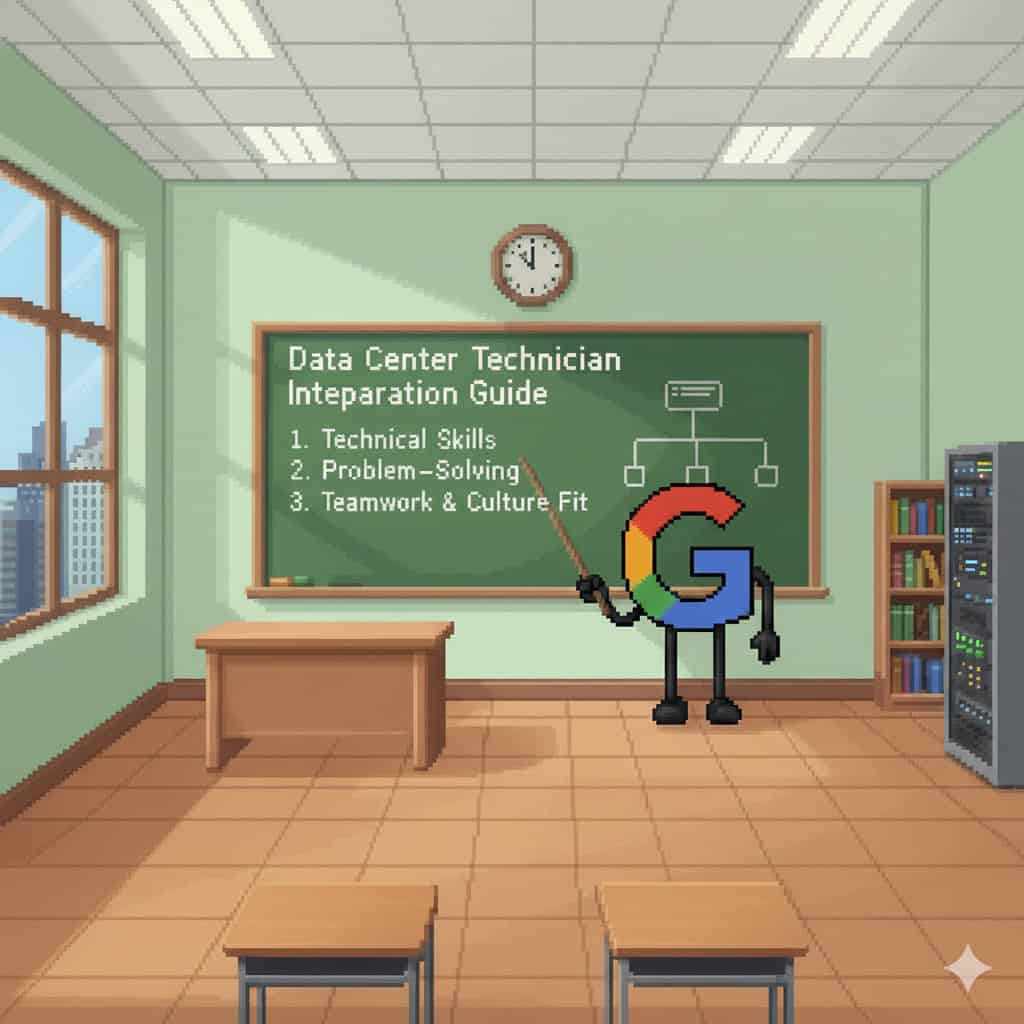
    In last week’s post I reviewed the skills Google suggests Data Center Technicians have before they apply for one of their open roles. This post reviews Google’s Data Center Technician interview guide (which you can read here) so those with an upcoming interview can hopefully succeed and get an offer. As a Data Center Technician III at Google who interviewed candidates I’m happy this guide is available. Now I have something to give those reaching out to me on LinkedIn asking for interview advice.

    Google’s Data Center Technician Interview Guide: Overview

    Per the website Google designs their interview with two principles:

    • Structured interviewing: Every candidate is assessed using clear rubrics. We use those rubrics for all folks being considered for that role, so that everyone is evaluated from the same perspective, allowing their distinctiveness to emerge.
    • Open-ended questions: We ask open-ended questions to learn how you solve problems. We want to understand how your mind works, how you interact with a team, and what your strengths are.

    What is is rubric? According to Indeed: “An interview rubric, also referred to as a hiring scorecard or scoring sheet, serves as a rating tool to evaluate job-relevant competencies during an interview.”

    Google’s Data Center Technician Interview Guide: Expectations

    Google explains in their interview guide that candidates will have multiple interviews. The recruiter will give the exact number and schedule.

    As for the type of questions, the guide explains they are open-ended. Meaning there aren’t any multiple-choice questions. This way the interviewers can learn how candidates approach and solve problems. Interviewers, like myself, can’t learn that from a multiple-choice question.

    So what type of questions do candidates have to answer? This is what so many people want to know when they reach out to me on LinkedIn or ask on my YouTube channel. Google lays it out:

    • Role-related knowledge (RRK): these questions will relate to the role and your past experiences. Be ready to discuss key role knowledge and industry expertise.
    • Problem solving: interviewers will be evaluating your problem-solving and critical thinking skills. They want to see how you strategically think through scenarios.
    • Leadership: for individual contributor roles, interviewers will look for leadership qualities that demonstrate your potential to grow into future roles. Questions will focus on your ability to get things done, work collaboratively, and strive for self-development.

    These guidelines are pretty self-explanatory. Candidates should be ready to answer questions related to the Data Center Technician role using their past IT experience. They need to showcase good problem-solving and critical thinking skills. Finally, candidates should demonstrate their leadership qualities from their previous and/or current roles as this displays potential to grow into future roles.

    Interview Preparation

    This section is quite long because this is vital to one having a successful interview. After reading the section I do agree with the preparation suggestions:

    • Showcase your strategic thinking
    • Listen carefully and clarify as needed
    • Demonstrate how you navigate complexity and ambiguity
    • Share how you work with people and teams
    • Think about your leadership style
    • Let us know about any accommodations you need

    Some candidates may be strong in these already. If one isn’t, then I highly recommend becoming proficient before the interview. Those individuals can consider participating in a mock interview with a friend or family member. Or they can pay for a mock interview. The latter may be better as those companies do provide actionable feedback and will give their clients the truth about their interview skills.

    I also suggest candidate write down answers to the above topics. If you can’t write down how you work with people and teams, or how you navigate ambiguous tasks then probably won’t explain those well during the interview.

    Look at the interview as an audition. You must practice over and over and over so you will have the best audition possible. If you don’t, then someone else will get the role.

    Behavior Interviews

    I’m glad Google’s Data Center Technician interview guide covers behavior interviews because I think too many candidates focus on the technical interviews too much. Thus, they are unprepared when it comes to behavioral questions.

    These are important because that’s how interviewers learn “how you’ve handled a specific challenge in the past to assess if you’ll be a good match for the role.”

    There’s more I want to say, but I don’t want to overstep any boundaries placed by my employer so I suggest individuals spend a considerable amount of time reading through that section on the guide. Then put into practice the STAR method the guide describes:

    • Situation: Describe the situation you were in or the task you needed to accomplish
    • Task: Explain the goal you were working toward
    • Activity: Detail the specific steps you took and the role(s) you played
    • Result: Describe your accomplishments and the overall outcome

    Use The Provided Resources

    I want to end this post to tell candidates to use the provided resources at the end of the guide. Especially if one has an upcoming interview.

    • Connect with a Googler

    If someone has more questions about the role to see if it will be a good fit for them then ask your recruiter to connect with a Googler. Candidates can also ask to have a mock interview with a Googler. I’ve done both of these with candidates. And one of those candidates now works at Google! (I’m not taking full credit for that because that person had to pass the interview, but I did help that person focus on their strengths and provide tips on how to calm their nerves.)

    • Leverage AI

    It’s fine to use Gemini to prepare for an interview. You can even have a mock interview with the LLM. However, do not use it during the interview! That’s a big no-no and you can (and probably will) get disqualified from the role.

    • Interview Warmup Tool to Practice Answering Interview Questions

    I learned about this tool some time back, but forgot about it until now. Go try it out!

    • Learn more about Google and the Data Center Position

    There are plenty of links on the guide to get more information so please visit them.

    Good luck!

  • Data Center Technician Skills Needed At Google

    Data Center Technician Skills Needed At Google

    One of the top questions I received on LinkedIn and my YouTube channel are the skills one needs to work as a Data Center Technician at Google (or another company). Until recently I would point those individuals to read this blog post I wrote some time back. Why did I change from pointing people to my website? Not because the information is outdated, but that Google released an official website detailing all the skills needed for the role. In this point I want to review the Data Center Technician skills needed at Google.

    Author’s Note: Although this website is geared toward roles at Google, the skills listed are pretty universal and apply to Data Center Technician roles at other employers.

    Data Center Technician Skills Overview

    There are three category of skills one needs to become a Data Center Technician at Google:

    • Infrastructure and hardware
    • Networking and connectivity
    • Problem solving and analytical skills

    Let’s review those in more detail.

    Infrastructure and Hardware

    According to the website, anyone interested in gaining the Data Center Technician skills to pass the interviews need to know the following:

    • Applied data security

    This means having the knowledge of how to handle a server to maintain data security. Thus, one should understand where data lives (such as a hard drive) and how to properly handle data so that person doesn’t compromise it and cause an incident.

    • Data center hardware architecture

    I’m glad Google points out this skill because there are plenty of individuals working in IT that don’t understand the type of hardware within a data center. They are used to office hardware, which is totally different. A person could learn this by watching videos on YouTube and doing research online. However, have physical experience is best.

    • Data center infrastructure

    The website suggest interested candidates know the network, cooling, and power works in a data center. Again, one can learn about this using YouTube. There are plenty of videos there about how a network, cooling structures, and power works in a data center.

    • Data center operating systems

    Candidates need to know how operating systems work when it comes to the boot process and how to troubleshoot issues. Which operating system do people need to know? Linux. It runs a majority of the servers powering the Internet today. However, if people only know Windows I suggest they learn how to use Linux.

    • Machine equipment and components

    Last, but not least, individuals need to know the types of hardware used in servers, how they interact with each other, and how to troubleshoot various types of issues. I always tell people this when they ask about a particular skill-set to study. If you don’t know your computer hardware and troubleshooting steps, you’re not going to get the job.

    Networking and Connectivity

    Now let’s review the suggested computer network skills:

    • Network equipment and components

    People need to know about the various types of network equipment commonly found in data centers. Good examples are fiber optic cabling, switches, routers, and optic transceivers to name a few. Wikipedia and YouTube are great resources to learn if someone doesn’t have experience.

    • Data center network architecture

    This skill can get very complex fast. Basically, the type of network within a data center is similar to one used in a home or office, but on a larger scale. Candidates going for a L1 or L2 Data Center Technician role need to know the basics about data center network architecture. However. those going for more senior roles need to know quite a bit.

    • Computer networking

    I suggest individuals know the Open Systems Interconnection (OSI) model and the common Internet protocols (such as TCP/IP, UDP, and DNS).

    Problem Solving and Analytical Skills

    The last Data Center Technician skills to learn is how to properly troubleshoot problems when they arise, be it on a server or within the network. They also need to understand where to find the information containing the error and other information so they can properly troubleshoot.

    As a L3 Data Center Technician at Google this is what I do everyday. If I’m not troubleshooting a network link or a machine, I’m finding information about the failures so I can do more research.

    Frankly, if one doesn’t have good problem-solving skills then passing the interview is going to be near impossible.

    How Can One Gain These Skills?

    I highly suggest those wanting to get one of Data Center Technician roles at Google to take and pass the Google IT Support Certificate. I took it myself just to see how it was because I used to suggest individuals get the CompTIA A+ certification. Read this blog post for my thoughts about the certificate.

  • I Got A Promotion!

    I Got A Promotion!

    I know it’s been too long since I posted something new on my blog. It’s been about 6 weeks since the last post. Yet, I’m back now and I do have some great news I want to cover in a series of post. The first of the great news is that I got a promotion! As of November 1, 2025 I will be a L3 Data Center Technician (DT) at Google. I worked with my manager for the past year on this move. I had to not only improve on my networking a new skill-set, but become highly proficient in it. And this was in addition of taking on additional leaderships roles not only on my team, but within my site.

    Since I got a promotion what does that change regarding my daily duties? Not much. Since I’ve worked as a L3 Data Center Technician for the past several months leading up to applying for the promotion what I have to do now is building upon my leadership and influence duties. I also have to sign up to join the on-call rotation, but I’ve done that before when I worked at the Twitter data center. However, I haven’t been on-call in a few years so that will be an readjustment. Oh, I did forget that I have to take on more of a mentorship role for the L1 and L2 DTs at my site. Some of them want advice on how they can progress in their career.

    Speaking of career, moving to a L3 role at Google now allows me to progress into a different technical role at the company. Including Software Engineering which is what I am interested in. As my manager told me when he gave me the great news last week now the hard work begins. Why? Because I need to figure out how to progress my career at Google. Does that mean I take on a 20 percent role and help out another team to earn experience? Or do I work on my own to develop that experience? I know this: I need to find a mentor again at the company in roles I’m interested in. That will really help with my career progression, in addition to my manager’s help.

  • I Stopped Studying

    I Stopped Studying

    There’s a reason why I haven’t posted anything to my blog in over a month: I stopped studying.

    There’s a good reason why: I had to focus on various checkups for my health. These checkups I ignored for a good number of years, even though I got email after email about setting up an appointment. Why did I do that? Because I felt fine. Like many people if I wasn’t sick there wasn’t a need to go to the doctor. Yes, I go to the eye doctor and dentist regularly because I do need glasses, and I have a chronic dental condition requiring care. Yet, visiting my PCP or woman doctor wasn’t a priority for me. That changed in June.

    I decided to go to the doctors during my birthday week in July because I promised my mom I would come home to celebrate my birthday. Thus, I called all the doctors and made appointments as all of my doctors are still in my hometown. (I’ve seen them for years and don’t want to change them.)

    Then I scheduled off time from work to handle all of this.

    I took my Grokking Algorithms books to read while on vacation, but I only read it a little.

    While I brought my laptop to do some coding, I wrote a few lines.

    At the end of July I stopped studying completely.

    August came and I had follow-up doctor appointments to attend. In addition, work became busy. Google Deepmind continues to drop new features to Gemini each week or two, which causes us Data Center Technicians to work more to deliver the TPUs needed to meet demand. As my workload continues to ramp up, my energy to study declines.

    Now it’s the middle September as I write this post and I still haven’t restarted studying. I want to, but I’m not sure what to study. I am unsure because I have some interesting stuff happening with me at work. Nothing I want to delve into now because I’m not sure how everything will pan out. If things go well, and I do a great job, I may have a new career goal. It’s not that I want to give up becoming a Software Engineer, but I can’t discount a new role that could work out better for me.

    So my plan for the rest of 2025 is to keep up my productivity at work, and do well in the new tasks happening also in my work life.